Here is an exercise I made for myself in iReal Pro to do the ii-V-I in the cycle.
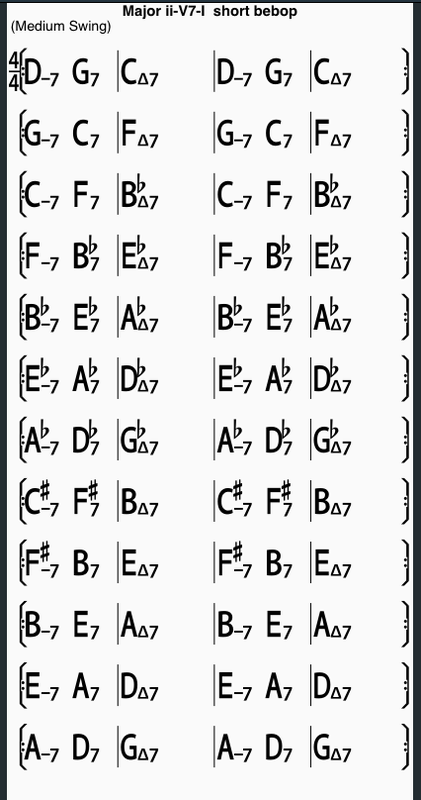
I'm still struggling with it, but here are steps I'm making to get better.
If I'm playing A-7 as the ii on a r6 'Dorian' box, I know where the G, its 3rd and its 7 is. There is one on the second string, 7th fret. I know the next 4th will be one string down, on the C. That means the next 'box' will be r6 Aeolian.
The boxes basically cycle like this:
After Phrygian, it starts over again with Ioninan, but one fret up from the last Ionian. Just like when I did the maj9 arpeggios in number 3 again. You can try doing this exercise again, except instead of saying the root note, say the r6 mode box where the root is in: Ionian, Mixolydian, Dorian, Aeolian, Phrygrian.
If I'm playing the r6 Mixolydian box in F, instead of going down, I can work back to the r6 Ionian in Bb and keep working backward in Ionian, Mixolydian r6 boxes.
Mixolydian works back and up to Ionian
Dorian works back and up to Mixolydian
Aeolian works back and up to Dorian
Phrygian works back and up to Aeolian.
- I'm learning bite-sized arpeggios, so I can quickly see the Root, 3, 5 and 7 when I find a root.
- I practice moving chords in fourths on the neck, figuring out the pattern.
- I am doing a Maj9 arpeggio of 1, 9, 3, 5 starting on the G of the sixth string, saying 'G'. Then I'm moving to the C on the 5 string and repeating the same arpeggio, saying 'C'. Then I move down to the F, then Bb, then the Eb (on the 4th fret now) and then Ab, saying all the names. Now I go to the A on the sixth string at fret 5 and continue through the cycle, playing the 1, 9, 3, 5 and saying the Root. Do this up the fretboard and back around. Note that the 9 is really the ii.
- Now when I play the exercise, I should start to recognize the movement of the roots, either backwards down the fretboard, or straight down towards string 1 and back up to six, going up the neck.
- When I see the first chord of the ii-V-I (e.g. A-7) I find the root and call it a ii. I realize the Root is a whole tone (two frets) down from the ii. I also visualize where the 3 of the I is. That is a good landing note for the I. The b3 of the ii is really a 4th away from the root. Eventually I'm starting to see the arpeggios, and, most-importantly, the 3s and 7s of the arpeggios of ii, V and I. Start to find ways to memorize these relationships. For instance, the b3 of the ii is also the b7 of the V.
- You can also focus on the I, find that, and then visualize the ii a whole town up, with its b3 falling on the 4 of the I.
- Try to anticipate where the next fourth is, either in terms of the ii or the I.
- I cannot really escape those mode boxes, so I'm always visualizing those in terms of the roots. For example, if I locate the A-7 on the second string (10th fret) I see the I7 will be a fret down, and at the 'tip' of the r6 Dorian scale shape. That means that the ii is in the r6 Mixolydian box. Eventually, I want to learn what box I am in if I call a note a 'ii' or a 'V' or a 'I'.
If I'm playing A-7 as the ii on a r6 'Dorian' box, I know where the G, its 3rd and its 7 is. There is one on the second string, 7th fret. I know the next 4th will be one string down, on the C. That means the next 'box' will be r6 Aeolian.
The boxes basically cycle like this:
- Ionian - root of I on 6, 4
- Mixolydian - root of I on 5, 3
- Dorian - root of I on 4, 2
- Aeolian - root of I on 3, 1
- Phrygian - root of I on 2, 5
After Phrygian, it starts over again with Ioninan, but one fret up from the last Ionian. Just like when I did the maj9 arpeggios in number 3 again. You can try doing this exercise again, except instead of saying the root note, say the r6 mode box where the root is in: Ionian, Mixolydian, Dorian, Aeolian, Phrygrian.
If I'm playing the r6 Mixolydian box in F, instead of going down, I can work back to the r6 Ionian in Bb and keep working backward in Ionian, Mixolydian r6 boxes.
Mixolydian works back and up to Ionian
Dorian works back and up to Mixolydian
Aeolian works back and up to Dorian
Phrygian works back and up to Aeolian.
 RSS Feed
